

The most widely used AI technology reads documents: 11.75% of EU firms, 3.57% in Romania
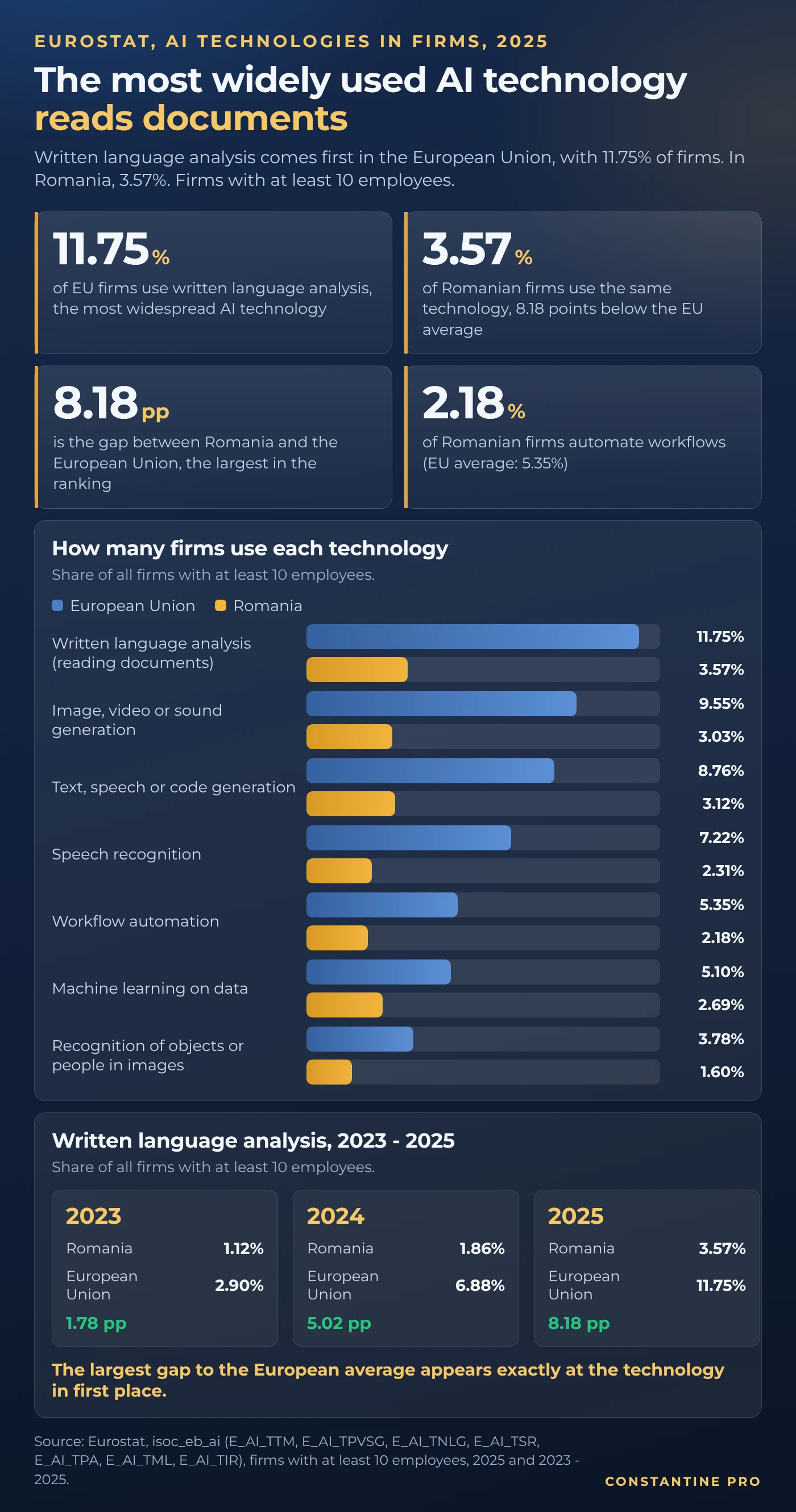
In 2025, 11.75% of firms in the European Union with at least 10 employees used written language analysis, the most widespread artificial intelligence technology. In Romania the same technology was used by 3.57% of firms, 8.18 percentage points below the European average.

- Published
- Updated
In 2025, 11.75% of firms in the European Union with at least 10 employees used written language analysis, meaning a program that reads documents written by people and pulls out the information the firm needs. It is the most widespread artificial intelligence technology of all those measured by Eurostat. In Romania the same technology was used by 3.57% of firms, 8.18 percentage points below the European average. The figures come from the Eurostat survey on the digital society, for firms with at least 10 employees.
Listen to the summary
The technology that reads documents is in first place
The ranking of artificial intelligence technologies looks like this in 2025. In the European Union, written language analysis comes first, with 11.75% of firms. Then image, video or sound generation, with 9.55%, text, speech or code generation, with 8.76%, speech recognition, with 7.22%, workflow automation, with 5.35%, machine learning on data, with 5.10%, and recognition of objects or people in images, with 3.78%.
| Technology | European Union | Romania | Gap |
|---|---|---|---|
| Written language analysis (reading documents) | 11.75% | 3.57% | 8.18 points |
| Image, video or sound generation | 9.55% | 3.03% | 6.52 points |
| Text, speech or code generation | 8.76% | 3.12% | 5.64 points |
| Speech recognition | 7.22% | 2.31% | 4.91 points |
| Workflow automation | 5.35% | 2.18% | 3.17 points |
| Machine learning on data | 5.10% | 2.69% | 2.41 points |
| Recognition of objects or people in images | 3.78% | 1.60% | 2.18 points |
In Romania the order is almost the same, only the values are lower: written language analysis 3.57%, text, speech or code generation 3.12%, image, video or sound generation 3.03%, machine learning 2.69%, speech recognition 2.31%, workflow automation 2.18% and image recognition 1.60%. The largest gap to the European average appears exactly at the technology in first place. In other words, firms adopt the part of artificial intelligence that reads and extracts information first, not the part that gives speeches.
The growth of the last two years
Written language analysis has grown quickly. In the European Union, from 2.90% of firms in 2023, to 6.88% in 2024 and 11.75% in 2025. In Romania, from 1.12% in 2023, to 1.86% in 2024 and 3.57% in 2025. Romanian firms holding this technology multiplied by 3.19 times in two years, while European ones grew 4.05 times. The gap between Romania and the European average widened, however, from 1.78 percentage points in 2023 to 8.18 points in 2025.
Workflow automation, the part that links the document that was read to the rest of the firm's software, grew too, but from a smaller base: 0.65% of Romanian firms in 2023, 1.12% in 2024 and 2.18% in 2025.
Small firms stay far behind large ones
For written language analysis, the distance between small and large firms is wide. Among Romanian firms with 10 to 49 employees, 2.79% use the technology, against 9.87% in the European Union. At firms with 50 to 249 employees, 5.36% in Romania and 18.22% in the European Union. At those with 250 employees or more, 15.05% in Romania and 35.04% in the European Union. Small firms have no technology person to carry the project, and the gap shows up in the numbers.
The flow behind it, step by step
A small firm in trade or services receives, on an ordinary day, a mix of documents: supplier invoices by email, orders written by a client in free text, contracts in PDF format, statements asked for by the accountant. Every document goes through the same steps:
- the document arrives, usually by email or through a portal;
- a person opens it and reads it;
- they look for the fields they need: who, what, how much and until when;
- they type them into the firm's software;
- they check whether the data matches what the firm already knew;
- if information is missing, they write back and wait;
- they archive the document where it can be found later.
Steps 1, 2, 3, 4 and 7 are reading and moving text from one place to another. A digital employee takes all of them over: it reads the document, extracts the fields, puts them into the software, flags what does not match and archives. The person stays on steps 5 and 6, where judgement is needed.
What stays with people
Checking mismatches, deciding, answering an unhappy client, negotiating, signing and taking responsibility stay with people. A digital employee does not replace judgement; it removes from the working day the part that repeats identically. That is why it is measured in hours, not in promises: how many documents arrive per day, how many minutes one document took before and how many minutes it takes after.
How a small firm starts
Not with a large project, but with a single flow. Pick the flow that consumes the most repetitive time, usually the documents that come in, measure for a week how long it takes now, describe step by step what is done with every document, then put a digital worker on it, with a person checking the result. If the flow does not repeat, it is not worth automating. If it repeats dozens of times a day, the hours add up on their own.
The infrastructure sits in the Constantine cloud, administered by us, so there is no need for a technology person inside the firm. That matters, because only 13.16% of Romanian firms with at least 10 employees have an information technology specialist, against 20.05% in the European Union.
If you want to see which flows eat the most repetitive time in your firm, write to us through the form on the site.